


What happens behind one AI question?
The journey from classroom to datacenter
Explain what a datacenter is as if I am 10 years old.
Chances are that students could now ask AI similar questions without giving it much thought. Maybe they use AI to summarize a text, better understand a difficult assignment or come up with ideas for a project.
You type your question, click ‘send’ and within a few seconds an answer appears on your screen.
But what actually happens in those few seconds?
Before AI can answer the question about what a datacenter is, it first needs to be processed. That requires computers, networks, data and a great deal of other technology. And a significant part of that is located in… a datacenter.
How does an AI question end up there? And what actually happens between the moment you click ‘send’ and the moment the answer appears?
From your screen to the cloud
When a student types in an AI question, the journey starts at the device: for example a laptop, tablet or phone. Via the internet, the question is sent to the systems needed to run the AI model.
We often call that the cloud.
But the cloud is not some magical place somewhere above us. The cloud consists of physical computers, servers, storage and networks. This infrastructure is located in various places: datacenters
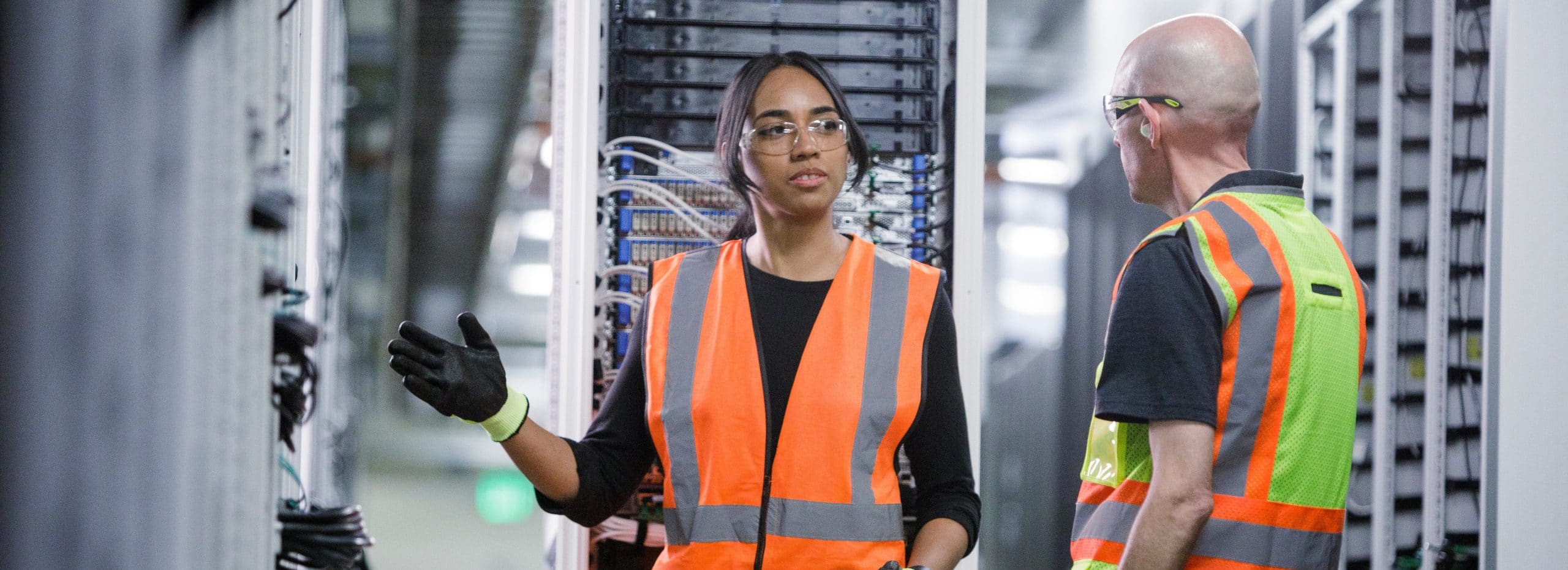
You can think of a datacenter as a large, well-secured computing environment. Inside are large numbers of servers that support digital services. They process and store data and make sure information is available whenever we need it.
So when a student asks, for example:
Explain what a datacenter is as if I am 10 years old.
This question is then sent via the internet to the systems running the AI model. There, your question is processed and the answer is generated. That answer is then sent back through the network to your device.
That may sound complicated, but it all happens incredibly fast.
What happens inside a datacenter?
A datacenter is a physical place that supports a large part of our digital world. Inside, you will find powerful computers that can process huge amounts of information. We call these computers servers.
Servers can perform various tasks. For example, they can run websites and apps, store files, make videos available, or carry out large, complex calculations for AI.
When someone uses AI, an AI model performs all kinds of calculations based on the question entered, in order to generate a suitable answer. The model has learned from huge amounts of information and uses that knowledge to work step by step towards an answer. This requires significant computing power. And the more people use AI at the same time, the more servers and capacity are needed to process all those questions.
For all these servers to function properly, more is needed than just computing power. Servers need to be able to communicate with each other and with the outside world via networks. They need electricity to operate, and because computers generate heat, cooling is essential too. In addition, security, backups and maintenance are important to keep the systems running reliably.
A datacenter is therefore much more than a room full of computers. It is a complete infrastructure in which servers, networks, energy, cooling and security come together to support the digital services we use every day.
Who makes sure everything works?
Behind this technology, people with all kinds of different knowledge and skills are at work.
Think of specialists who work with servers and hardware, people who manage networks, cybersecurity experts and technicians who deal with energy, cooling and maintenance. AI and cloud specialists also play an important role.
A datacenter is therefore not just about computers. It is an environment where different kinds of technology and people come together.
This shows how much lies behind the digital services we use every day. For education, this offers a great opportunity to show students that working with technology is much broader than just programming. From infrastructure and cybersecurity to energy, engineering, data and AI: different fields all contribute to the digital services we use every day.
Technology that is becoming increasingly important
We use more and more digital services in our daily lives. We send messages, watch videos, listen to music, take photos, use social media, play online games and look things up on the internet. And increasingly, AI is part of that too.
All these applications rely on digital infrastructure. Behind something as simple as opening a photo or streaming a video, systems are at work that make sure the right information is available at the right moment.
As the use of digital services and AI grows, so does the need for datacenters, networks, energy and professionals who can build and manage this technology.
That makes it relevant for students to think not only about what AI can do, but also about what is needed to make AI work.
From understanding to discovering
That is exactly what the Dream Space Datacenter Education Tour is about.
During this workshop, students and teachers discover what happens behind everyday technology. How does the cloud work? What happens to data? What role do servers, networks, energy and cooling play? And how do AI and datacenters come together?
Through interactive assignments, participants get an accessible introduction to the world of datacenters, cloud technology and AI.
For teachers, the tour offers a practical way to make topics that often remain abstract more tangible, connecting them to the technology students use every day.
Curious how you can take students into the world behind AI?
Let students experience it for themselves during the Dream Space Datacenter Education Tour.